Overview | Managing in the Moment | Navigating Instructional Flow | Assessing with Purpose | The Framework Documents
The Core Teaching Framework – Overview

The Core Teaching Framework © 2026 by Mike Wendling is licensed under CC BY-SA 4.0. It is free for anyone to use or modify with proper attribution.
A Guide to Teacher Practice and Growth
Core Teaching is a framework for understanding the foundational practices of teaching: managing the classroom environment, planning and delivering instruction, and assessing student learning. Developed by a 28-year veteran middle school teacher, it is not a prescribed methodology but rather a way of thinking about these foundations and how they weave together. It enhances student learning and achievement by strengthening teacher practice. It is compatible with teacher evaluation systems such as Danielson, Marzano, and others and supports any school type, approach, philosophy, curriculum, or school-wide assessment and management system.
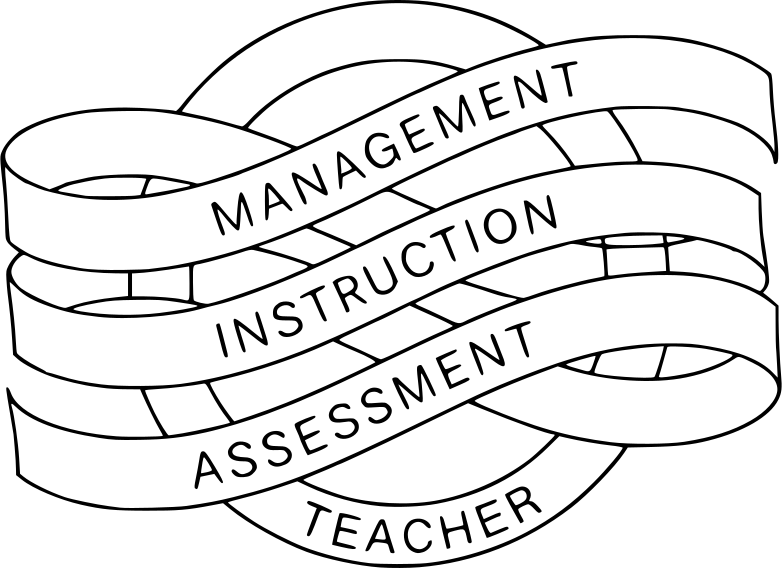
The three foundational practices are deeply interconnected. What happens in one affects the others. Classroom management impacts instruction. Assessment reveals whether instruction is working. Good planning and instruction reduces management challenges. Effective teaching requires developing skill in all three practices and understanding how they work together to create the conditions for learning.
The Principles of Core Teaching
Each foundational practice is described in principles. These principles bring a structure to each practice that is grounded in the daily realities of teaching and provide a direction for teacher growth. The framework itself has two basic principles.
First Principle: The teacher is the anchor of the classroom.
It is the teacher who holds the weave of the foundational practices together. By managing the environment, navigating toward learning goals, and assessing to support growth, the teacher creates the conditions in which students can learn.
Second Principle: Schools come in many types with different philosophies and approaches to teaching and learning. The foundational practices are the same.
From the smallest home school to the largest public school district, the practices of teaching are the same. Learning goals and methods may vary; values and emphases may be different, but all teachers must manage the classroom environment, navigate toward learning goals, and assess student learning.
Overview | Managing in the Moment | Navigating Instructional Flow | Assessing with Purpose | The Framework Documents
The Core Teaching Framework – Managing in the Moment

The teacher anchors the classroom environment.
Managing in the Moment addresses how teachers construct and maintain classroom environments, build relationships that make learning possible, and respond effectively to disruption. The teacher serves as the anchor, a source of stability that holds the environment together.
This framework is organized around three interconnected elements: the classroom environment the teacher constructs, the relationships among teacher and students that make the environment work, and the moments when the teacher must guide the classroom through disruptions and return to learning.
Part 1: Constructing the Environment
First Principle: The teacher is the anchor of the classroom.
The students are the reason the classroom is there, but it is the teacher who determines what and how things happen. Being the anchor is not just a position of authority; it is a source of stability. Teachers of all personalities can hold the environment together. They are the ones who make the school’s curriculum and discipline plans work. This is why good teachers are indispensable.
Second Principle: The teacher constructs and maintains the classroom environment.
The environment the teacher constructs includes containment, support, structure, involvement, and validation.
Containment means physical and emotional safety. Physical safety involves making the best use of the physical space of the classroom and having structures in place to manage movement and resources within the space. Emotional safety in the classroom includes safety to try, safety to ask questions, and safety to make mistakes. Regardless of whatever other experiences students may bring with them to the classroom, it can and should be a safe place for them.
Support means that the students feel that the teacher is there to help them academically, socially, and emotionally. This doesn’t mean that teachers should not call out bad behavior and bad choices. In fact, doing so is essential. Students should, however, recognize that the teacher is there to help them.
Structure means intentionality in everything that is done in the classroom. Patterns of time and activity are predictable. This doesn’t mean that there can’t be variations or that special times don’t call for special structures, but the day-to-day should be routine.
These structures should include: lessons, activities or materials; energy levels; assigned work and grading routines (including plans for the return of graded work), plans for distribution and collection of materials and any other variable that affects the flow of the environment of the classroom.
These don’t necessarily always need to be formalized, but some classes, subjects, or age-groups may need more formal structures to work effectively. Some of these structures may need to be fluid as the environment changes and may have to be adapted for different groups of students or for students at different times of the day. When expectations are clear and consistently maintained, students experience safety in predictability. When boundaries are firm students learn they can trust the structure to hold. Students thrive in effective structures.
Involvement means that the teacher and students are all participating in the life of the classroom. In some ways it is a by-product of safety, structure, and support but it needs to be encouraged and nurtured in its own right. It can also mean helping those who are more involved and often contribute to make space for others. It is a matter of belonging.
Validation means that every student feels that who they are has worth and value. Effort, taking good risks, and trying are encouraged, acknowledged, and celebrated. Students’ thoughts, questions, and concerns are respected. Mistakes are understood as situations to be fixed. Even when a student causes harm to the classroom environment, the inherent worth of that person is maintained. Students are recognized as more than just their presence and performance in the classroom.
Classroom culture must be consistent with and reflect the culture of the school and the greater community that the school serves. Teachers should actively find ways to make sure that the environment they are creating is consistent with these greater contexts even if they don’t necessarily reflect the teacher’s experience.
Part 2: Relationship as Foundation
Third Principle: Relationship is the foundation that makes management work.
From the smallest home school to the largest public school district, the practices of teaching are the same. Learning goals and methods may vary; values and emphases may be different, but all teachers must manage the classroom environment, navigate toward learning goals, and assess student learning.
The classroom environment works because the teacher builds relationships with students. These relationships are the bridge between the structures the teacher creates and the moments when those structures are tested.
Strong teacher-student relationships can take many forms. All forms do require, though, that students experience the teacher as someone who sees them as individuals, believes in their capacity to succeed, understands that challenging behaviors are not always intentional, remains steady even when students test boundaries, and maintains high expectations while providing genuine support.
Teachers can build effective relationships with students through: being a consistent, reliable presence; noticing and acknowledging student effort and growth; being interested in students’ lives outside the classroom; demonstrating both high expectations and support; and working to repair relationships when they are ruptured. This foundation can be critical when trying to redirect students and neutralize disruptions.
Part 3: Managing the Moment
Fourth Principle: The teacher is constantly monitoring and managing the environment; adjusting to the energy of the classroom.
As the anchor of the classroom, the teacher is reading the room, sensing shifts in energy, and trying to anticipate problems before they escalate. This requires situational awareness and the willingness to enter into developing situations early. Adjustments can be subtle or direct, public or private, loud or soft, individual or group. All have value. While teachers may feel more aligned with certain approaches they should be able to use all of them and recognize when and how to use each one.
Fifth Principle: Transitions happen throughout the day and must be actively managed.
Transitions occur: from home to school, from class to class, from activity to activity, from one energy and structure level to another (class to lunch, lunch to class, class to break or recess, break or recess to class, one teacher to another teacher, school to home). Properly structuring and managing these transitions is key to managing the class. Many disruptions happen during transitions because the structure temporarily loosens. Being intentional about how transitions happen can help prevent most of these problems.
Sixth Principle: At moments of intense disruption, the primary goal of the teacher is to return the classroom environment to its proper balance.
Most of the time, a well-constructed classroom environment runs fairly well with minimal adjustments by the teacher., but other times the energy of the classroom is different, requiring more extensive adjustments. Sometimes it is possible to sense potential disruptions (students who look ready to cause a problem or a situation ready to get out of hand) and make adjustments before the disruptions occur.
Other times, it isn’t possible, and the teacher faces the moment when a student or students engage in a major disruption which may involve a direct challenge to the teacher or creating a situation where the teacher must respond directly. These disruptions can have many sources and may have little or nothing to do with the actual situation in the classroom. Students may not be able to respond rationally in these times. Keeping that in mind can help teachers act effectively and dispassionately.
These disruptions may call for consequences as defined in a school’s policies, a restoration process to deal with the harm caused to the community, or an analysis of the cause of the disruption. In the moment, however, the primary goal after student safety is the return of the classroom environment to its primary goals and functions. Other elements can and should be dealt with, but later.
Seventh Principle: Teachers can best respond to disruptions when they move and act from their professional center.
A centered teacher can remain calm and effectively respond to disruptions, including ones where they may feel emotionally or verbally attacked. This professional center is built from the teacher’s personality, personal mission, values, and experience. It is the foundation that keeps the teacher balanced and personally anchored.
When teachers react with emotions (quick-tempered words, defensive posture, taking things personally), they are already pulled off-balance. When teachers move and act from their professional centers, corrections and deescalations are grounded in the entire classroom environment and relationships they have established. They are unshakeable.
For example, most teachers have faced a student who has challenged the teacher’s ability, the effectiveness of a particular activity, or even the value of the subject matter. This can easily pull a teacher off his or her balance leading to an escalation of the disruption. A teacher acting from a professional center can recognize the challenge for what it is and return the class to its proper balance.
Eighth Principle: Do not struggle against resistance. Redirect the energy.
Struggle leads to escalation. What is more often called for is de-escalation. Sometimes this means just standing firm and solid, recognizing that the challenge, like the one in the seventh principle, is not substantive. Sometimes it means guiding the resistance or disruption to a place where it is not causing harm. Giving the student one or more ways to return to the work of a class can end the immediate situation right there. If rules have been violated, there can and should be consequences. If relationships have been harmed, restoration can and should occur. Because the teacher has remained anchored, the class remains anchored. An anchored class can work through any challenging situation.
Read more in Classroom Management – The Teacher as the Source of Stability
Overview | Managing in the Moment | Navigating Instructional Flow | Assessing with Purpose | The Framework Documents
The Core Teaching Framework – Navigating Instructional Flow

The teacher navigates toward learning goals.
Navigating Instructional Flow addresses how teachers plan instruction, ground lessons in clear learning goals, and adjust responsively as teaching unfolds. The teacher guides the class through curriculum, monitoring student progress, and dealing with obstacles. This practice emphasizes both planning ahead and responding to current conditions. It is tightly woven with assessment.
Part 1: Planning for the Flow
First Principle: Use a brief plan to outline the year.
The year-plan is a map to help the teacher see the big picture of the overall flow. It only includes the major topics, chapters, or units, overarching learning goals and a rough time-frame. Every year has a shape determined by holidays, special events, and planned disruptions to the schedule. Even before considering the needs of specific classes and students, how the flow happens can change quite a bit from year to year. This can have implications for planning, instruction, and assessment.
Second Principle: Use a more detailed plan for the present and near future.
This plan includes more specific detail about specific learning goals, instructional methods, activities, and assessments. Variations can occur. Sometimes students need an extra day or two on a particular topic or goal. Sometimes an unexpected disruption (assembly, power outage, copier down, etc.) occurs. Sometimes a unique opportunity or idea comes from a student that is worth taking time for. It is a teachable moment and should be honored. This plan helps the teacher make the best decisions for the current circumstances. It allows teaching to be responsive to the day-to-day realities and flow of the classroom.
Third Principle: Revisit plans on a regular basis.
Review plans on a regular basis to help make intentional changes while understanding the impacts on assessments and the flow of the year.
Fourth Principle: Use school, district or system adopted programs and curricular materials as the first source for lessons, activities and assessments.
These materials have typically been developed by experienced educators, vetted for alignment with standards, and selected for good reasons. Combined with any curricular guides or maps, they can provide a strong foundation for the flow. Starting with adopted materials also saves time and energy. Teachers can focus their creative energy on adaptation, differentiation, and responding to specific student needs while they navigate the flow.
Fifth Principle: Not all lessons, activities, and assessments from these programs may work well with students and classes all the time.
In some cases, making some modifications to existing materials may be adequate. In other cases, alternative or supplemental materials may be required. Over time, teachers should build up a toolkit of additional lessons and activities that meet the needs of different classes, students, or time frames. These additions provide alternate pathways for meeting learning goals and help with the realities and the constraints on time in a given school year. There are many sources for additional materials including colleagues, conference or workshop attendance, lesson plan databases, and online stores. Teachers can also develop their own materials to meet the unique needs of their communities.
Part 2: Instruction in the Flow
Sixth Principle: When selecting and planning for a lesson, activity, or assessment, start with the essential learning goals then consider the range of learners.
Every lesson, activity, or assessment is grounded in one or more essential learning goals. Visualizing how that goal will be met in a particular class helps the teacher prepare scaffolds and extensions. It also helps the teacher consider time frames and management variables in the flow of the classroom. The process of visualizing involves looking at the lesson or activity directions while trying to anticipate how the students might respond. It can help to consider examples of both the strongest and weakest students. Visualizing considers problems the students might have, questions they might ask, and possible challenges in distributing and collecting work or materials. It also considers what knowledge or skills might be assumed but need review or scaffolding. Finally, it can help predict the need for any changes to standard procedures and routines. This allows the teacher to prepare specific instructions for those changes. These visualizations are not always completely sufficient, but they can help. Teachers can improve their visualization skills through practice.
Seventh Principle: As the lesson, activity or assessment unfolds, monitor student understanding, energy and participation and adjust as needed.
Teachers are continuously monitoring student engagement and success with learning goals through observations and assessments of all kinds. Student facial expressions and body language can often give a good preliminary indication of how students are responding to a lesson or activity. A lack of student questions can mean students think they understand or have no idea what is going on. Resolving this can be as simple as probing further or informally assessing as the lesson or activity proceeds.
Teachers can often gain more information about student understanding by moving through the room as students work. Teacher presence can help students refocus on their work thus supporting management. Students who wouldn’t ask a question in the full-class setting might be willing to ask it when working in a small group or independently. Seeing the work students are doing as they do it is an important kind of informal assessment. It can help the teacher clear up any confusions or misconceptions right as they happen.
Calibrating noise and activity-level in a classroom can be challenging. Noise can be an indication of both student involvement with the work or distraction from the work. The need for different energy-levels as measured by noise and movement can be different for different purposes. Expectations for noise and movement of a class creating skits in response to a reading assignment are going to be different than for a class using heat sources or dissecting tools in the science lab. It is also worth noting from a management perspective that even positive, high energy-levels can increase the risk of disruptions occurring. This is a part of the calibration process.
It is sometimes necessary to make adjustments of the flow in the moment. It is also sometimes necessary to end a lesson or activity that isn’t working and reset, revise or replace it. This can include recognizing that the class is not currently able to follow the plan but will be at another time. It can be helpful for teachers to have a low or no prep go-to activity for when the regular lesson fails or in case it ends early. Student progress toward learning goals should be the primary guide for all real-time instructional decisions.
Read more in Every Year is Different: Why Mechanical Solutions are Not Enough
Overview | Managing in the Moment | Navigating Instructional Flow | Assessing with Purpose | The Framework Documents
The Core Teaching Framework – Assessing with Purpose

The teacher grounds assessment in learning.
Assessing with Purpose addresses how teachers navigate the sometimes competing purposes of grading: documenting progress, ranking performance, and influencing learning. The teacher’s view of student performance includes observations of the student work that produced particular scores and grades. It is closely interwoven with planning and instruction.
Part 1: Understanding Assessment
First Principle: Grades are a subset of assessments.
Assessments flow along a spectrum, moving from informal and ungraded observations through lower-stake formative checks, ultimately reaching higher-stake summative grades.
Second Principle: Parents, administrators, and students should be able to look at grades and gain accurate information about student performance.
The grades in a grade book should tell a story or paint a picture of how a student has performed over the course of a grading period. Where possible, grades should show the progression from the introduction to and initial work with learning goals towards greater, summative assessments. This can help students, parents, and administrators see patterns and help adjust a student’s trajectory.
Third Principle: The complete picture of student performance is complex and imperfect.
The complete picture of student performance includes grades, ungraded process observations, and external assessments such as standardized testing. There can be discrepancies in these various measurements which makes the overall picture more complex, but that is a reflection of the overall imperfection of the process. It is not a flaw, just a reality.
One student might test well but not complete daily work. Another student might struggle with timed tests but demonstrate deep understanding in projects and discussions. Yet another might perform well in class but poorly on standardized measures.
The teacher’s professional vision, developed through daily observation, interaction, and assessment, is what makes sense of these discrepancies. The teacher serves as the anchor that keeps grading grounded in the reality of student learning beyond just grades and scores.
Summary grades tend to be volatile when there are few grades in the system such as at the beginning of a grading period. By the end of a grading period, summary grades should be stable enough that any anomalous grades show very little impact on the summary grades.
Part 2: Designing Assessment Systems
Fourth Principle: Taking grades is a process of strategic data collection.
As with any exercise in data analysis, more data points can lead to a better understanding of the whole but only if those data points are meaningful and manageable. Quality matters as much as quantity. Grades should build from smaller, more frequent assessments toward larger, more summative ones. This progression provides early warning when students are struggling. Small daily grades reveal problems before they become larger failures.
Having too many assessments, however can create noise rather than clarity, overwhelming both teacher and students and leading to assessment fatigue. Different kinds of assignments and assessments contribute to a more complete picture of student performance, but this must be balanced with the time and effort both students and teachers must invest.
Fifth Principle: In K-12 education, we are not just teaching subjects, we are introducing students to the importance of consistent and sustained effort in learning and achieving goals.
Consistent effort and work should have value in the grading system. Including them in the grading system demonstrates a commitment to them. Doing so can also address two particular problem areas common to the grading process. The first is the student who does well on assessments but ignores daily work. Small assignments that are easy to create and grade can keep this kind of student from achieving the highest levels of distinction without regular participation and engagement. The second is the student who works hard and steadily, but may struggle with certain kinds of assessments. These same small assignments can help recognize the real achievements of these students.
The consistent work dimension of grading teaches students that sustained effort matters, and that the process of learning has value beyond just the final demonstration of knowledge. It also provides the teacher with ongoing information about student engagement and understanding.
Sixth Principle: Understanding how a summary grade is calculated is essential to calibrating assessment.
Point systems, weighted grades, and standards-based systems all have strengths and weaknesses. The teacher must understand the mechanics of those systems to create a calibrated and accurate description of student performance. Choices of what and when to grade, point values, and categories can have a tremendous impact on summary grades. Decisions should be made intentionally with the goal of presenting the most accurate view of student performance.
Part 3: Using Assessment to Support Learning
Seventh Principle: Grading should be aligned with expectation, instruction, and practice.
This may seem obvious, but it isn’t always easy to see and do. Even the most experienced teacher can create an assignment to be graded then discover that what was actually being assessed was different from expectation, instruction, and practice or activity.
When grading reveals gaps in student understanding, the teacher must make professional judgments about next steps. The assessment itself may have been misaligned with what was taught or practiced. More practice or engagement with knowledge may be required. In some cases, the teacher’s judgment may be to move on recognizing that this content will need to be reinforced at another time.
Eighth Principle: Calibrate grades to challenge strong performers while supporting weaker performers.
Part of strategic assessment is making sure that strong performers are challenged and academic rigor is maintained while weaker performers are nurtured.
This requires careful planning and thoughtful design of assessments and assignments. Strong students should encounter work that stretches their thinking and doesn’t allow them to coast on natural ability alone. Struggling students should have opportunities to demonstrate growth and mastery without being buried by tasks that are inaccessible to them.
This doesn’t mean different standards for different students. It means providing multiple pathways to demonstrate learning, scaffolding that provides access without lowering expectations, and extension opportunities that push high achievers beyond minimum competency.
Ninth Principle: Teachers can and should reflect and adapt when grades seem misaligned.
Any assessment may have a degree of imperfection in it or in the preparation for it. Teachers can and should reset, revise, or replace when a set of grades seem out of the norm. This may involve adding a new grade or replacing a grade if a significant discrepancy in alignment is discovered. Teachers should make sure that any steps they take in this regard are consistent with their school, district or system administrative policies.
Read more in Effective Assessment – Working Through The Imperfections of Grading
Overview | Managing in the Moment | Navigating Instructional Flow | Assessing with Purpose | The Framework Documents
The Framework Documents
Below are the framework documents listing and introducing the principles. These documents are released under the Creative Commons CC BY-SA 4.0 license which means it is free for anyone to use and adapt with proper attribution.
The Core Teaching Overview
The Core Teaching Overview is an introduction to the Core Teaching Framework, who it is for, and the beliefs that ground it. Its icon is a ship’s helm because the teacher is the one directing the journey of the class.
Navigating Instructional Flow
Navigating Instructional Flow addresses planning and instruction. Its icon is a compass because the teacher navigates to the learning goals for the class making use of assessment along the way.
Assessing with Purpose
Assessing with Purpose addresses assessment and grading. Its icon is a sextant because the teacher is continually measuring how the class is progressing with learning goals.
Managing in the Moment
Managing in the Moment addresses classroom management. Its icon is an anchor because the teacher anchors the classroom environment.
Overview | Managing in the Moment | Navigating Instructional Flow | Assessing with Purpose | The Framework Documents
Compatibility with Teacher Evaluation Frameworks
There are many teacher evaluation frameworks in use throughout the country. Danielson and Marzano are two of the most common, but others such as the TAP System and Stronge and Associates are also in use. Some states such as Texas and Georgia have their own evaluations. All these frameworks comprehensively define what a good teacher does.
The Core Teaching Framework has a different goal. It takes the most essential actions of teaching, the core practices, and helps teachers think through how to make these practices work in the messy, day-to-day world of the classroom. The framework is designed to facilitate teacher thinking, process, and growth. The Core Teaching Framework is not an alternative to these evaluation frameworks. It is a way to help teachers find a way to meet the standards of these other frameworks.